The day the wire from a sale lands, most business owners lose the finance department that has been running their financial life. For years, the company handled tax planning and reporting without anyone calling it wealth planning. Whether you sell, recapitalize, or pass the company to your children, that work moves to the family balance sheet.
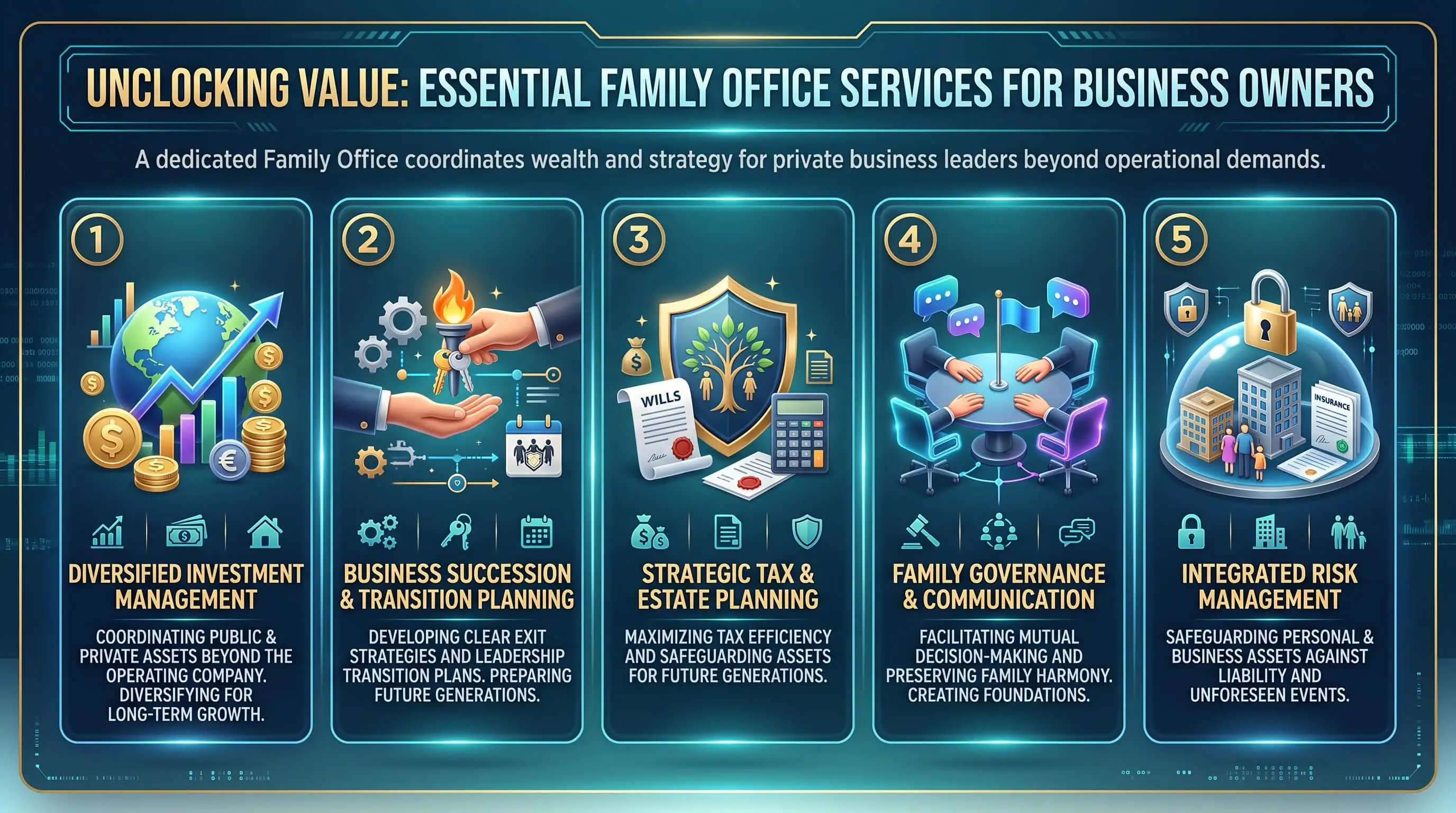
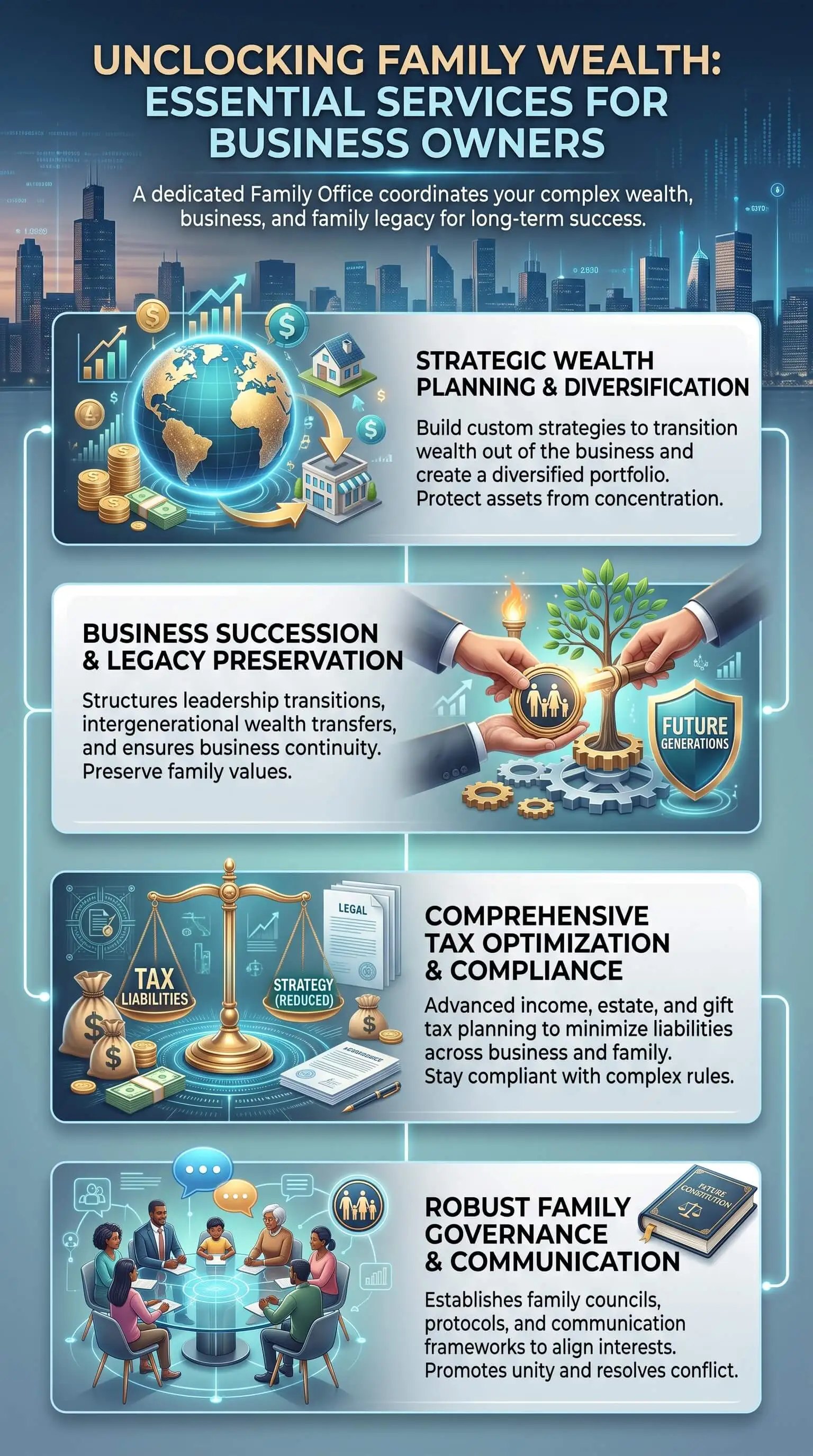
At that point, most owners need five kinds of support from a family office: tax strategy, trust and estate planning, business transition planning, investment oversight, and family governance. That is why family office trust and business transition services for business owners look so different from what a salaried executive needs.
Many of the owners we meet are also parents writing tuition checks. The person comparing the cost of private education for a child is often the same person deciding who will run the company in ten years. Both decisions draw on one balance sheet, so they belong in one plan.
TL;DR Quick Answers
Family Office Trust and Business Transition Services for Business Owners
These services rebuild the planning your company used to handle, so the family has a structure in place before and after a sale or succession. The highest-leverage window usually closes before anyone signs a Letter of Intent.
Trust planning: may move future appreciation outside the taxable estate before the company turns to cash, depending on the facts and review by qualified counsel.
Transition planning: entity cleanup, buy-sell review, after-tax proceeds modeling, and an exit team with one quarterback.
Tax strategy: federal, state, and local exposure modeled before closing, with tax reserves set after.
Family governance: clear decision rights and heir preparation, so the wealth outlasts the transaction.
Best fit: owners one to three years from a sale, recapitalization, or handoff to their children.
Top Takeaways
Owners most often need tax strategy, trust and estate planning, transition planning, investment oversight, and family governance working from one plan.
A sale moves the planning work your company did onto your family's balance sheet.
The best planning window usually closes before anyone signs a Letter of Intent.
Complexity, more than net worth, decides whether you need a family office.
Tuition, succession, and wealth transfer draw on the same balance sheet and belong in the same plan.
Why Business Owners Need a Different Kind of Wealth Support
Founders build wealth differently than executives do. An executive builds it through a paycheck and a diversified portfolio, while a founder usually has most of their net worth tied up in one private company that is illiquid and hard to value.
That concentration created wealth. It also hid a lot of work, because the company quietly handled tax planning and financial reporting on your behalf for years.
When the company sells, that work stays with you. The system that did it leaves with the buyer, which is where virtual outsourced finance and accounting services can help carry that work forward.
The Core Family Office Services for Business Owners
Each service below replaces a function your company used to perform, rebuilt around the family.
Personal CFO and advisor coordination. Your CPA, M&A attorney, estate attorney, and banker may each be excellent. Without a quarterback, you end up relaying messages between them in the middle of a deal.
Tax strategy. Model federal, state, and local exposure before the transaction. The tax bills keep coming after closing, too, through estimated payments, installment sales, and trust returns.
Trust and estate planning. When you expect company value to rise or turn liquid, pre-transaction trust planning may let future appreciation sit outside the taxable estate. Whether it fits depends on the facts and on review by qualified tax and legal counsel.
Wealth transfer. Gifts to the next generation work best on a schedule the family sets, not one a closing date forces on you.
Business transition and liquidity event planning. Clean up the cap table, operating agreements, and buy-sell provisions before buyers start diligence. Know your likely after-tax proceeds before you negotiate.
Family governance and their preparation. Inside the company, everyone knew who decided what. Families need that same clarity, and children rarely learn the purpose of wealth by accident.
Investment oversight. After a sale, the portfolio replaces the company as the family's engine. It needs a written investment policy.
Philanthropy. Charitable structures you set up before a sale may offer planning options that are harder to capture once the proceeds are cash.
Trust and Business Transition Services: Where Timing Matters Most
Most of the expensive planning mistakes we see happen before anyone signs a Letter of Intent.
Once an LOI exists, your options narrow. Valuation discounts get harder to support and transfer strategies draw more scrutiny, while every decision starts running on the buyer's timeline. Your attention moves to diligence and closing, which is exactly where it belongs.
Time is leverage.
That is the case for putting a family office for business owners in place while enterprise value is still enterprise value. At that stage, you may still be able to shape trust funding, state tax domicile, charitable planning, and liquidity modeling. After the wire lands, many of those choices get harder to make.
Which Services Do You Actually Need Right Now?
Your stage in the life of the business matters more than any net worth figure.
Still growing the company. Get estate documents current, clean up your entities, and bring in a Personal CFO who sees the whole picture.
One to three years from a sale. Add pre-sale tax modeling and trust planning, and name a quarterback for the exit team.
Mid-transaction. Keep the personal planning track moving alongside the deal.
The first 12 months after closing. Set tax reserves, a cash policy, and an investment policy statement before new opportunities start arriving, and agree as a family on how to handle requests from relatives.
Handing the company to your children. Focus on governance, their readiness, succession timing, and a gifting strategy that fits all of it.
Family Office vs. Wealth Manager vs. Doing It Yourself
A family office is not the right answer for every owner. If the business is already sold, your estate plan is current, and your wealth is simple and liquid, a traditional wealth manager may be all you need.
Investment portfolio management: A wealth manager and a family office both handle it. On your own, it is yours to run.
CPA and tax strategy coordination: You coordinate it yourself, a wealth manager helps in limited ways, and a family office owns it.
Trust and estate planning coordination: Expect limited help from a wealth manager and full coordination from a family office.
Business transition and liquidity planning: Rarely addressed when you go it alone, sometimes by a wealth manager, and central to a family office.
Entity and trust oversight: A family office function that most owners and wealth managers rarely cover.
Family governance and heir preparation: Also a family office function, and the one owners skip most often.
One accountable point across all advisors: Not possible on your own and limited with a wealth manager. A family office is built around it.
The useful question is how complex the job has become. Running a portfolio is one job. Running a newly liquid family enterprise is a bigger one, and that is where outsourced family office executive services and family-office-level support earn their place.
"In our work with owners approaching a sale, one pattern keeps showing up. The business was their operating system. It ran the finance function and set the rhythm of the week, and after closing, nobody is managing those needs anymore. The owners who come through well built their personal structure before the wire hit. When we trace a costly mistake back to its source, we usually find a sound decision made in the wrong order rather than a bad investment."
7 Essential Resources
Use these sources to sharpen your questions before you sit down with advisors.
Exit Planning Institute: State of Owner Readiness. National and regional surveys of how ready owners actually are to exit. Read it before you rate your own readiness.
IRS: Frequently Asked Questions on Estate Taxes. Filing thresholds, the 2026 basic exclusion amount, and how the IRS values business interests in an estate.
IRS: Frequently Asked Questions on Gift Taxes. Worth reviewing if you plan to move shares to family members before a sale.
U.S. Small Business Administration: Close or Sell Your Business. A plain federal overview of selling, transferring, or closing a business, including which professionals to bring in.
Cerulli Associates: $124 Trillion Wealth Transfer Projection. The scale of the generational shift your family's plan is part of.
U.S. Chamber of Commerce: Resources for Family-Owned Businesses. A short list of organizations that support family business succession and governance.
The Cost of Private Education: What You Need to Know. Education funding sits on the same balance sheet as the business, and this guide covers what private school actually costs.
3 Statistics
$124 trillion will change hands through 2048. Cerulli Associates projects that $105 trillion of it will go to heirs and $18 trillion to charity. Why it matters to you: the advisors and heirs involved in your family's transfer are changing along with that volume. Source: Cerulli Associates
Only 20% to 30% of businesses that go to market actually sell. The Exit Planning Institute reports that up to 80% of owners who try to sell end up without solid options to harvest their wealth. Why it matters to you: when you prepare the business and the family early, you give yourself more ways to reach a good outcome. Source: Exit Planning Institute
The federal basic exclusion amount is $15 million for 2026. The IRS confirms the increase from $13.99 million in 2025 under Public Law 119-21. Why it matters to you: a higher exclusion creates room to plan, but a company's value can pass it quickly once a sale turns shares into cash. Source: IRS
Final Thoughts and Opinion
Most owners start with the wrong question. They ask where the proceeds should go. The better question is what structure needs to exist before the proceeds arrive.
We rarely meet owners who lack good advisors. What they lack is coordination. The CPA sees the tax return and the attorney sees the documents, while the wealth manager watches the portfolio and nobody watches the whole family balance sheet. So the owner carries it, usually during the busiest stretch of their career.
Our view is that family office services for business owners earn their place when the job gets complex, and a net worth figure alone will not tell you when that happens. If you are one to three years from a transaction, or already wondering which of your children might lead the company, the complexity has probably arrived.
You ran the company on systems. Your family needs one too.
Frequently Asked Questions
What services does a family office provide to business owners?
A family office coordinates tax strategy, trust and estate planning, wealth transfer, business transition planning, investment oversight, family governance, and philanthropy. For an owner, the core value is one accountable team that keeps every advisor working from the same plan.
When should a business owner hire a family office?
Usually one to three years before a sale, recapitalization, or family succession. Planning that early may preserve options around trusts, taxes, entity structure, and state tax domicile that get harder to use once you sign a Letter of Intent.
How much wealth do you need for a family office?
Complexity matters more than a fixed number. Family-office-level coordination often becomes valuable around $10 million or more [VERIFY], especially when a business sale, concentrated stock, or multigenerational planning is in the picture. For simpler, fully liquid wealth, a traditional wealth manager may be the better fit.
What trust structures do business owners use before selling a company?
Depending on the facts, attorneys may look at grantor trusts, spousal lifetime access trusts, or charitable vehicles. The aim is often to move future appreciation outside the taxable estate before the company becomes cash. Any of these requires review by qualified tax and legal counsel.
What are business transition services?
They prepare the company and the family for a change in ownership. That work covers entity cleanup, a review of buy-sell provisions, after-tax proceeds modeling, and building an exit team, plus deciding what the family balance sheet needs after closing.
Is a family office different from a wealth manager?
Yes. A wealth manager typically focuses on the investment portfolio. A family office manages the family's broader financial life, including taxes, trusts, entities, insurance, advisors, and governance, and treats investments as one part of that system.
Can a family office help pass a business to my children?
Yes. It can coordinate gifting strategy, trust planning, succession timing, and family governance so the transfer fits both the tax picture and each heir's readiness. In our experience, the conversations at the kitchen table matter as much as the documents.
How does a family office help with private school and education funding?
Tuition and education savings are part of the family's long-term cash flow. A family office folds them into the same plan as the business transition, along with gifts to children or grandchildren. If you are weighing school options, this guide to paying for private school is a good place to start.
Build the Personal Structure Before the Wire Hits
If a sale, recapitalization, or family succession is on your horizon, the planning window may be narrower than it appears. Legacy Bridge Private Family Offices helps business owners coordinate tax, trust, transition, and family decisions before and after a liquidity event. Schedule a private consultation and start building the structure your next chapter requires.