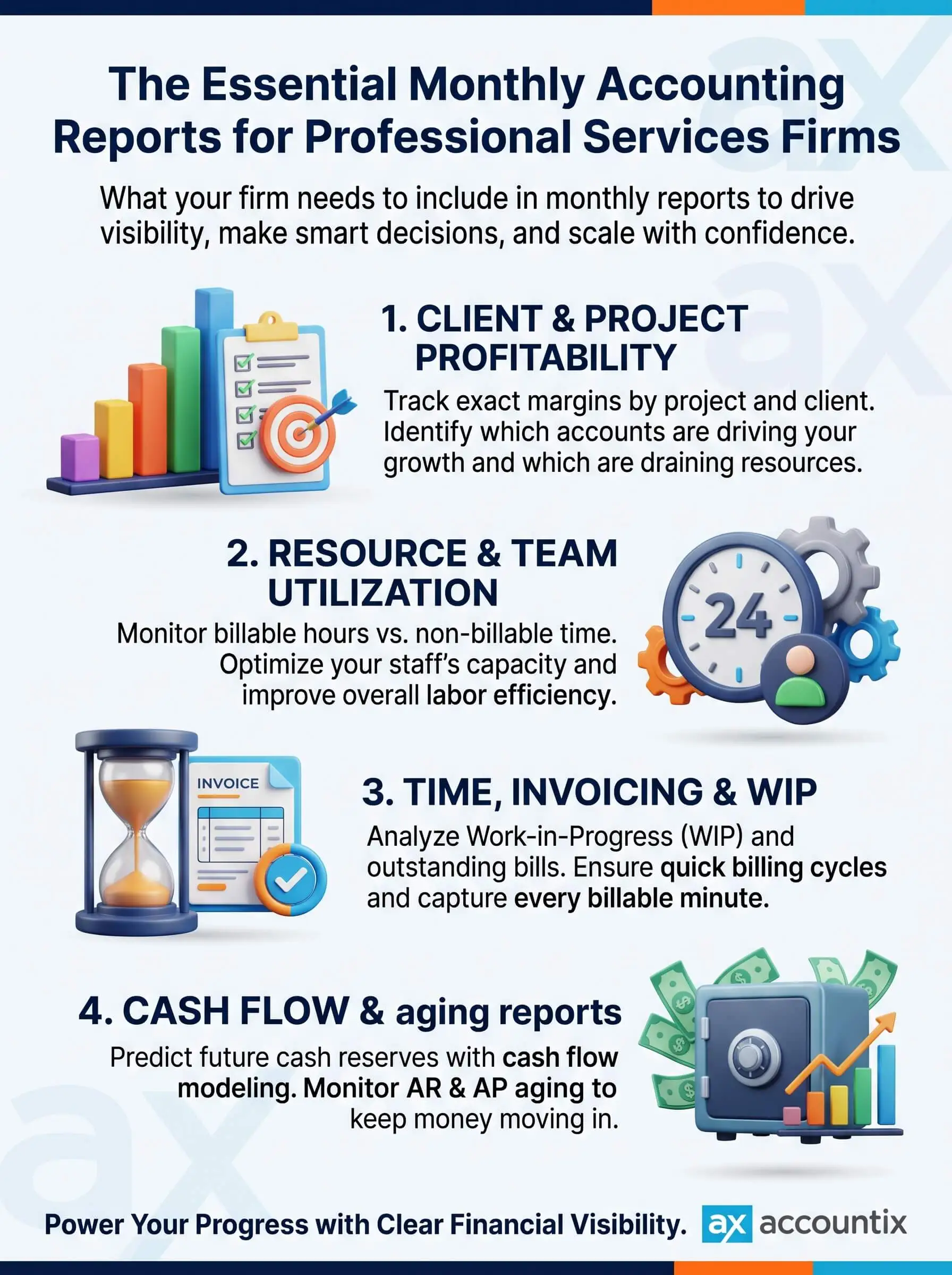
Plenty of professional services firms close the month with accurate books and still can't say which clients made them money. The answer is a monthly report package built around how the firm actually earns: a P&L by client or service line, a balance sheet, a cash flow statement, AR aging, work in progress (WIP), utilization and realization, project profitability, budget vs actual, and partner distributions.
Accounting for professional services firms needs that extra depth because your inventory is time and expertise. A standard P&L will confirm the firm turned a profit in March. It won't show you that two retainers lost money that month, or that a few weeks of finished work are still sitting unbilled.
All of it rests on clean bookkeeping: every transaction coded correctly and the books closed on the same day each month. Skip that step and every report downstream inherits the errors.
This applies to consulting practices, law and accounting firms, architects and engineers, agencies, and the educational consultants who guide families through private school admissions. The work looks very different from one to the next, but the reporting problem is nearly identical. Each one sells hours and judgment, and each needs to see where those hours go.
TL;DR Quick Answers
Accounting for Professional Services Firms
Accounting for professional services firms is bookkeeping and financial reporting built around billable time, because a services firm's inventory is time and expertise. Beyond clean monthly closes, it tracks:
Utilization and realization: how much team time is billable, and how much of it gets invoiced and collected
Work in progress (WIP): finished work that hasn't been billed yet
Job costing: profitability by client, project, and practice area
AR aging and DSO: how long clients take to pay
Partner draws and distributions: payouts tied to actual profit and available cash
Rolling cash forecasts: pipeline mapped against payroll to time hiring decisions
The payoff is visibility. Leadership can see which clients and engagements drive margin and stop guessing where it slips.
Top Takeaways
A firm-wide P&L can hide unprofitable clients, and splitting it by client or service line brings them into view.
WIP and AR aging, read together, show whether cash is stuck before the invoice or after it.
Utilization means little without realization, since busy hours that never get billed don't become revenue.
A rolling cash forecast tells you when to hire and when to hold off.
The firms that get the most from their reports review the same package on the same day each month, with a named owner for every variance.
Why Accounting for Professional Services Firms Needs Its Own Report Package
A retailer can count what's on the shelf. A services firm sells billable time, and that time changes shape several times before it turns into cash. Hours get worked, some get billed, invoices go out, and clients pay on their own schedule. Margin can slip at any of those handoffs.
That's why accounting for professional services firms has to ask more of the monthly close than tidy books. Retainers arrive up front and get earned over months. Milestone billing stacks revenue into a few heavy months and leaves thin ones in between, the feast-or-famine cycle most partners know well. Draws often follow the bank balance instead of actual profit. A report package designed for a product business misses nearly all of it.
Accrual accounting matters here too. Under the accrual method, you record income when you earn it and expenses when you incur them, whatever day the cash moves. The IRS explains both methods in plain terms. For a services firm, accrual reporting keeps one big collection month from passing as a great month, and keeps a slow-paying client from dragging down a strong one.
The Monthly Accounting Reports Every Professional Services Firm Needs
Each report below answers a question leadership should be asking every month, and each comes with one number worth watching.
P&L by client, project or service line: Which work actually makes money? Watch gross margin per engagement.
Balance sheet: What does the firm own and owe? Watch working capital and deferred revenue.
Cash flow statement: Is profit turning into cash? Watch the operating cash flow trend.
AR aging: Where is cash stuck? Watch days sales outstanding (DSO).
WIP and unbilled revenue: What have we done but not billed? Watch WIP aging.
Utilization and realization: Is capacity being used, and paid for? Watch billable % and realize %.
Job costing and project profitability: Which projects ran over? Watch budgeted vs actual hours.
Budget vs actual and rolling forecast: Are we on plan, and what's coming? Watch variance by line and the 3 to 6 month cash outlook.
Partner compensation and distributions: Are payouts in line with cash and profit? Watch draws vs distributable profit.
KPI dashboard and financial narrative: What changed this month, and why? Watch revenue per FTE and effective rate.
Profit and Loss by Client, Project or Service Line
A P&L by client shows revenue and direct costs for each relationship instead of the firm as a whole. We often see firm-level margins that look healthy while two or three clients quietly run at a loss underneath. Splitting results by client or service line tells you which work deserves more of the team's time and which needs repricing.
Balance Sheet
The balance sheet shows what the firm owns and what it owes on a given date. Watch deferred revenue closely. A retainer collected in advance stays a liability until the work is delivered, and booking it as income early makes the month look better than it was.
Cash Flow Statement
Here's the report that explains why a profitable month can still leave the operating account thin. It follows cash in from clients and out to payroll, rent, and partners. Firms on milestone billing usually spot the feast-or-famine swing here months before they feel it.
Accounts Receivable Aging and DSO
AR aging sorts unpaid invoices by age, from current through 30, 60, and 90-plus days. Days sales outstanding (DSO) boils that down to one figure: the average number of days it takes to get paid. Once an invoice drifts past 60 days, it needs a phone call rather than another automated reminder.
Work in Progress and Unbilled Revenue
WIP is the value of work your team has finished but hasn't invoiced. Few reports give an earlier warning. When WIP climbs, either billing has fallen behind or the team is doing work nobody agreed to pay for, and in both cases the revenue is at risk.
Utilization and Realization Report
Utilization measures how much of the team's available time went to billable work, while realization measures how much of that billable time was invoiced and collected. Read them side by side. High utilization paired with weak realization almost always traces back to write-downs, scope creep, or retainers priced too low.
Job Costing and Project Profitability
Job costing compares budgeted hours and costs against actuals for each engagement. It settles the argument partners tend to have without data, which is whether a given project made money. Give it a few months and the pattern gets hard to ignore, showing which kinds of work the firm prices well and which it keeps underestimating.
Budget vs Actual and Rolling Forecast
Budget vs actual puts the month's results next to plan, line by line, so someone explains the variances while they're still fresh. The rolling forecast looks three to six months out and maps the pipeline against payroll. If you're trying to decide when to hire your next associate, this is the report that answers it.
Partner Compensation and Distributions
Draws, profit pools, and distributions deserve their own report, tied to actual profit and to the cash the firm has on hand. Without one, partners can take out money the firm hasn't earned yet. Owners thinking about wealth planning beyond the firm may also find this guide to what family office services business owners actually need useful.
KPI Dashboard and Financial Narrative
The dashboard puts the handful of numbers leadership reads every month on a single page, usually revenue per FTE, effective billing rate, margin, DSO, and utilization. Add two or three sentences on what changed and why. In our experience, partners act on numbers that arrive with an explanation and skim past the ones that don't.
What This Looks Like in Practice
Take an educational consultancy that guides families through private school admissions. Its heavy season runs through fall and winter as applications come due, and the team works on each file for months before sending the final invoice. Without a WIP report, those months look unprofitable on paper. Without a cash forecast, the slow summer catches the firm short.
A private school consultant runs a professional services business like any other, so the same reporting discipline applies. Businesses that serve schools directly face similar pressures, as this look at accounting services for small businesses that work with private schools explains.

"When we take on a new professional services firm, the books are usually in decent shape. What nobody can tell us is which clients are carrying the firm and which ones the firm is quietly carrying. We almost always find finished work sitting in WIP for weeks, and partners taking draws based on last month's bank balance instead of this month's profit. Fixing it is rarely complicated. Pick a close date and hold it, send the same report package every month, and sit down for 30 minutes where someone has to explain the variances out loud. Firms that keep that habit for a single quarter stop guessing where margin slips."
7 Essential Resources
IRS Publication 583, Starting a Business and Keeping Records: The IRS's plain-language guide to recordkeeping, financial statements, and monthly bank reconciliations. Worth a look if you want to confirm your close covers the basics.
IRS Publication 538, Accounting Periods and Methods: Covers cash versus accrual accounting, including the rules for personal service corporations in law, accounting, engineering, architecture, and consulting.
U.S. Small Business Administration: Manage Your Business: The SBA's overview of bookkeeping, balance sheets, and accounting methods, plus who on your team should own receivables, payables, and payroll.
SPI Research 2026 Professional Services Maturity Benchmark: The benchmark most firms cite for professional services KPIs, built on data from 509 organizations. Useful when you want to compare your utilization and margins with peers.
Kantata: The Most Important Professional Services KPIs: Formulas and worked examples for WIP, realization, utilization, leverage, and gross margin.
Bitrix24: Track Utilization Before You Track Revenue: A practical piece on reading utilization next to realization, with a simple grid for what each combination tends to mean.
Firm360: Accounting Firm KPIs That Show Whether Your Firm Is On Track: Written for partners, it covers realization, utilization, workload, and WIP and AR aging, along with how often to review each.
3 Statistics
Billable utilization fell to 66.4% in 2025, the lowest level in 19 years of tracking, according to SPI Research's 2026 Professional Services Maturity Benchmark of 509 firms (source). For a smaller firm, it's a reminder that real capacity rarely matches what partners assume, and a monthly utilization report is how you find out.
Firm-wide realization has hovered between 85% and 90% in recent years, based on the Rosenberg benchmark survey as reported by Firm360 (source). Even well-run firms leave 10% to 15% of their billable value uncollected. Tracking realization each month shows whether your gap comes from a deliberate pricing choice or a slow leak.
Average days sales outstanding across professional services firms sits near 47 days, compared with roughly 34 for high performers, per Monograph's 2026 KPI guide (source). Thirteen extra days on every invoice ties up real working capital, and a monthly AR aging review is the simplest way to win some of it back.
Final Thoughts and Opinion
Our honest view is that the habit of reading the reports matters more than which reports you pick. We've worked with firms that had polished dashboards nobody opened, and with firms that reviewed a handful of plain reports on the same day every month. The second group made better calls.
If ten reports sounds like a lot, start smaller. A P&L by client, AR aging, and WIP will show you where most of the money is going and where it's stuck. Add utilization and realization the following month, then bring in the forecast and partner reporting once the close runs on schedule.
What makes it stick is the same approach we use with every firm we support, which is people, process, and technology working together. You need an experienced advisor to interpret the numbers and a close that runs the same way each month. You also need systems that connect time tracking, billing, and the books, so the reports build themselves instead of eating a partner's Saturday. This approach also applies to accounting for nonprofits, where consistent reporting and connected systems help organisations maintain financial transparency and accountability. Once that's in place, the monthly package turns into the most useful hour on the calendar.
Frequently Asked Questions
What is accounting for professional services firms, and how is it different from standard bookkeeping?
Accounting for professional services firms treats time and expertise as the inventory. On top of standard bookkeeping, it tracks billable utilization, realization, unbilled work in progress, project profitability, and partner distributions, so leadership can see which clients and engagements actually make money.
Which monthly financial reports matter most for a small consulting or service firm?
Start with a profit and loss statement by client, an accounts receivable aging report, and a work in progress report. Together they show who's profitable, who's paying on time, and what finished work hasn't been billed. Add utilization and a cash forecast as your close matures.
What is a good utilization and realization rate for a professional services firm?
That depends on role and firm type. SPI Research's 2026 benchmark put average billable utilization at 66.4%, and the Rosenberg survey places firm-wide realization between 85% and 90%. Partners usually run lower utilization than staff because business development and management take up part of their week.
How often should a professional services firm close its books?
Every month, on a fixed schedule, ideally within the first two weeks of the following month. That keeps the reports current enough to act on. If you wait until quarter-end, problems like rising WIP or slow-paying clients have already cost the firm money by the time anyone sees them.
What is work in progress (WIP) in professional services accounting?
Work in progress is the value of work your team has completed but not yet invoiced, which you find by subtracting the amount billed from the value of completed work. Rising or aging WIP is an early sign that billing has fallen behind or that the team is doing out-of-scope work.
When should a firm move from a bookkeeper to outsourced accounting or a fractional CFO?
When partners are spending non-billable hours managing cash flow, or when the books are accurate but can't answer forward-looking questions. If you can't map your pipeline against payroll or decide with confidence when to hire, outsourced accounting or fractional CFO support is the next step.
Get Clear Monthly Reporting for Your Firm
If your books are clean and you still can't say which clients are carrying the firm, the gap is in the reporting. Accountix builds monthly reporting packages for professional services firms that bring utilization, WIP, project margins, and partner economics into one view, and we walk through them with you on a schedule you can count on. You shouldn't have to guess where the margin slips.
Book an intro call with Accountix for a 30-minute conversation. No obligation, just clarity.


