The family signed its new estate planning documents in March, the same spring their oldest was accepted to private school. A year later, the brokerage account meant for the new trust still sat in the parents' names. The attorney expected the advisor to retitle it. The advisor believed the attorney already had.
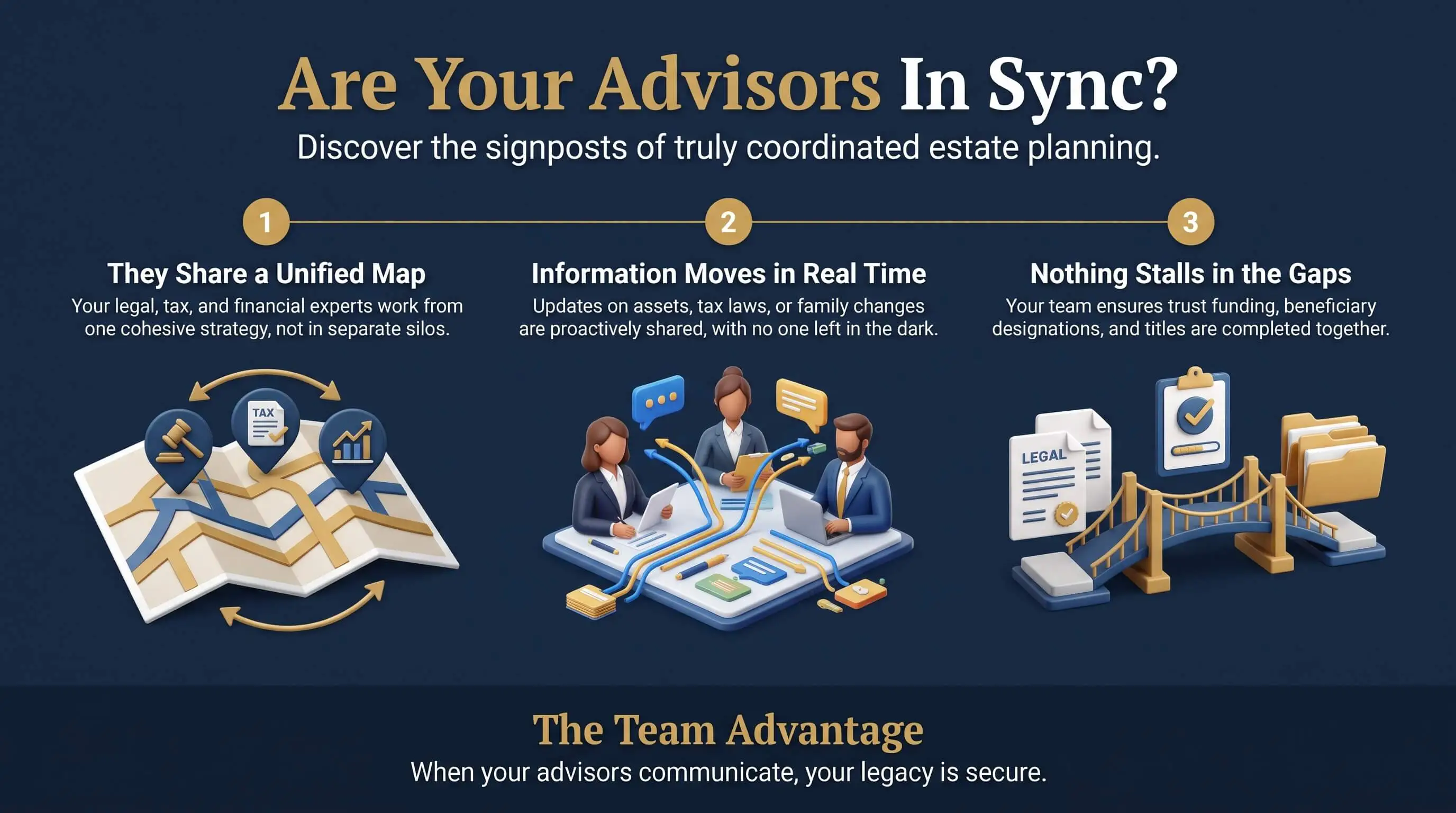
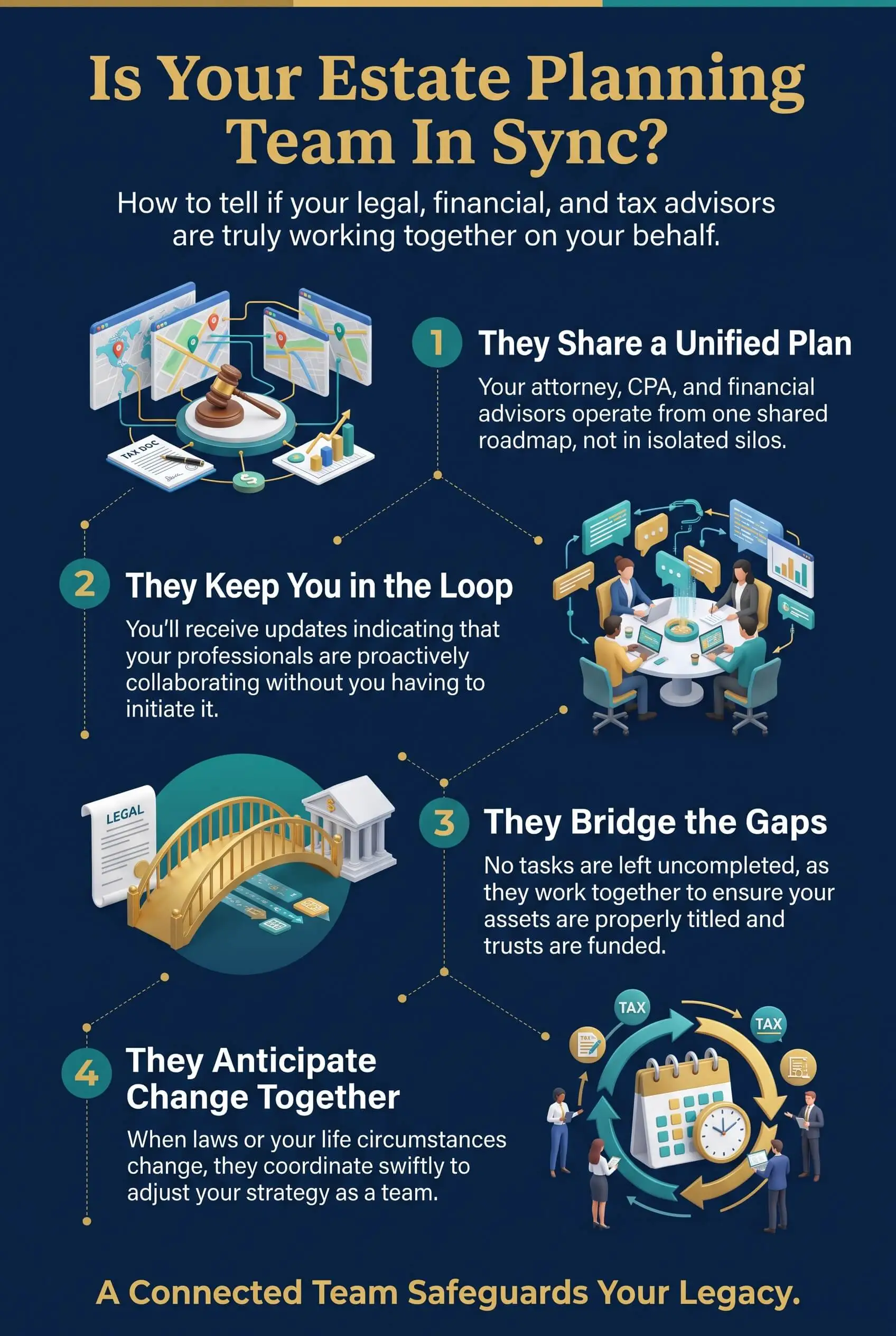
You can usually tell whether your professionals are communicating by checking two things: whether one person owns implementation, and whether your accounts actually match your documents. If nobody can say who confirms trust funding, titling, and beneficiary forms after signing, your plan has a gap that estate planning coordination exists to close.
Parents planning for private school tuition often make estate decisions in the same season, and both draw on one balance sheet. The handoffs between professionals tend to break in the same few places.
TL;DR Quick Answers
Estate Planning Coordination
Estate planning coordination moves your plan from paper to practice. One accountable point connects your attorney, CPA, and advisors, then confirms that every account, title, and beneficiary form matches what your documents say.
What it covers: trust funding, asset titling, beneficiary designations, and joint plan reviews.
Who does what: your attorney drafts and advises, your CPA handles tax, and a coordinator drives implementation to completion.
How it works: inventory and review, coordinate the professionals, implement and verify, then maintain.
When to review: once a year, and again after any major life event, transaction, or change in law.
Signs you need it: you relay messages between advisors, or nobody has confirmed what your trust holds.
What it prevents: assets landing in probate, outdated beneficiaries, and missed tax planning.
Top Takeaways
Your professionals are communicating when one person owns implementation and the team reviews the plan together each year.
Relaying messages between advisors, unverified trust funding, and mismatched beneficiary forms are the clearest warning signs.
Most estate plans break down after signing, during implementation.
Estate planning coordination keeps accounts, titles, and beneficiaries aligned with your documents as life changes.
Your attorney and CPA stay the technical experts, and coordination adds the follow-through between them.
Why Good Advisors Still Miss Each Other
Your estate planning attorney works from the documents. Your CPA works from the tax returns, and your financial advisor from the portfolio. Each may do excellent work, yet none of them sees your family's whole financial picture.
In most families, nobody in that group is engaged to watch the full plan through family office concierge services, so the family becomes the courier, carrying questions between offices and hoping the answers line up. When we trace a gap back to its source, the cause is almost always a structure where no one owns a follow-through rather than a weak professional.
7 Warning Signs Your Estate Planning Team Is Not Communicating
If two or more of these sound familiar, the answer is usually estate planning coordination rather than a new set of documents.
You relay messages between your advisors. Forwarding your attorney's emails to your CPA makes you the project manager by default, whether you want the job or not.
Your trust exists, but no one has confirmed what it holds. A trust controls only the assets titled to it. Until someone checks trust funding account by account, part of your estate may still pass outside the plan.
Your beneficiary forms say something different from your documents. A retirement account that names "my children" can override a trust your attorney drafted to hold their share. In most cases the form controls, even when it conflicts with what you meant.
Your CPA hears about major moves after they happen. A business sale or a Roth conversion can reshape your tax picture and your estate plan in one stroke. If your CPA learns about it at filing time, the planning window has already closed.
Each advisor gives you a different answer to the same question. That usually points to a different set of facts on each desk rather than a mistake by any one person.
Nobody can say when the plan was last reviewed together. We recommend an annual review, plus updates after major life events, transactions, or changes in law. When the team has never met as a group, the plan ages in separate filing cabinets.
Your children would not know whom to call first. If your heirs can't find the documents or the people behind them, they'll end up rebuilding the plan during the hardest weeks of their lives.
What Poor Coordination Can Cost Your Family
These costs rarely appear on a statement. Most surface only when your family actually needs the plan.
Assets meant for a trust can land in probate because no one retitled them.
An outdated beneficiary form can send a retirement account to a former spouse or bypass a trust built to protect a child.
Your attorney may not recommend estate tax planning without seeing the growth projections your advisor has modeled.
Heirs may spend months gathering account lists and paperwork that one person could have organized years earlier.
Every one of these traces back to implementation rather than drafting, which is exactly why a family can prevent them.
How Estate Planning Coordination Fixes the Gaps
Estate planning coordination carries the legal intent in your documents through to your accounts, titles, entities, and beneficiary designations, then keeps it current as life changes. Your attorney and CPA remain the technical experts. Coordination supplies the follow-through between them.
In one Legacy Bridge case study, coordinating a family's advisors and guiding family conversations helped update a complex estate plan and saved the family more than $3 million in taxes across generations. Every family's results depend on its own facts.
Inventory and review. Map accounts, entities, policies, titles, and existing documents in one place.
Coordinate the professionals. Bring your attorney, CPA, and advisors to the same table and agree on implementation priorities.
Implement and verify. Track trust funding, retitling, and beneficiary updates until someone confirms each one is complete.
Maintain and refine. Keep records current and revisit the plan each year so it stays execution-ready as your family and assets change.
Who Should Be the Quarterback?
Someone has their own implementation. For a simpler estate, an engaged financial advisor can handle it. Families with multiple entities, trusts, properties, or a business often do better with a Personal CFO or family office. What matters most is who will answer for the follow-through, far more than who drafted the documents.
"In our work with families, plans rarely break in the attorney's office, but they often break in the months after signing, when someone opens a new account in an individual name or leaves a beneficiary form untouched after a divorce. At a first meeting, we ask whether the attorney, CPA, and advisor have ever been in the same room. Most families have to stop and think. Good documents start the work, and the family's intent holds up years later only when someone keeps checking the accounts against the paper."
7 Essential Resources
Bring the questions these raise to your next meeting with your advisors.
Coordinating Your Estate Plan, Martin M. Shenkman, Esq. (Montecito Bank & Trust). A veteran estate planning attorney walks through how attorneys, CPAs, trust officers, and advisers can work as one team.
Kitces: How Financial Advisors and Estate Planning Attorneys Can Work Together. Shows where the advisor's role ends, where the attorney's begins, and why the two do better work side by side.
Should My Financial Advisor Talk to My CPA? (Mullooly Asset Management). A short, plain-language look at what goes wrong when advisors work in silos, starting with the unfunded trust.
Pierce Law: How a Financial Planner Coordinates With an Estate Planning Attorney. Draws the line between coordination and legal advice, so you know which professional should answer which question.
IRS: Frequently Asked Questions on Estate Taxes. Current filing thresholds and exclusion amounts, best reviewed with your CPA and attorney in the same conversation.
Caring.com 2025 Wills and Estate Planning Study. National data on how many Americans have a will and how often they update it.
Affording Private School in Virginia: Tips from an Expert. Tuition and estate planning draw on the same balance sheet, and this guide covers the education side.
3 Statistics
Only 24% of U.S. adults reported having a will in 2025, down from 33% in 2022. Caring.com and YouGov surveyed more than 2,500 adults. Why it matters to you: if you already have an estate plan, you are ahead of most families, and coordination keeps that work from drifting out of date. Source: Caring.com
42% of Americans say they would not know what to do if a family member died today. Trust & Will surveyed 5,000 U.S. adults between January 28 and February 5, 2026. Why it matters to you: a plan only your advisors understand leaves your family guessing at the hardest moment. Source: Trust & Will 2026 Estate Planning Report
Only 20% of heirs who have received an inheritance say they would keep their benefactor's advisor. Cerulli Associates reported in September 2025 that the figure is 27% among heirs still expecting an inheritance. Why it matters to you: when your professionals never meet the next generation, the knowledge behind your plan can leave with the transfer. Source: Cerulli Associates
Final Thoughts and Opinion
Most families assume a gap means they need better advisors. In our experience, what they need is one accountable point between the advisors they already trust.
We see the pattern often. The documents are sound and the professionals are capable, yet the plan drifts anyway. A refinance moves the house out of the trust, or a child turns 18 and nobody revisits the guardian provisions. Each change looks small, and together they can pull a well-drafted plan a long way from what the family intended.
Our view is that estate planning isn't finished at signing. It's finished when every account, title, and beneficiary form matches the documents, and it stays that way only while someone keeps checking. That ongoing check is the work of estate planning coordination.
If your family showed up in two or more of the warning signs, ask your attorney, CPA, and advisor to review the plan together this year. How they respond will tell you a great deal.
The plan worth having is the one your family can actually use.
Frequently Asked Questions
What is estate planning coordination?
Estate planning coordination carries the legal intent in your documents through to your accounts, titles, entities, and beneficiary designations, then keeps it current as life changes. It connects your attorney, CPA, and advisors so the plan works in practice and not only on paper.
How do I get my estate attorney and CPA to work together?
Give written consent for them to share information, then ask for a joint review meeting and bring a current list of accounts, policies, and entities. If neither professional takes the lead on follow-up, name a coordinator, such as your financial advisor, a Personal CFO, or a family office, to track action items to completion.
Who should coordinate my estate plan?
Whoever is accountable for implementation. An engaged financial advisor may be enough for a simpler estate. Families with multiple trusts, entities, properties, or a business often benefit from a Personal CFO or family office that keeps every professional working from one plan.
What happens if my trust is not funded?
A trust controls only the assets titled to it. Assets left outside an unfunded trust may pass through probate or under a beneficiary form instead of the trust's terms. That can mean delays and outcomes you never intended, so someone should verify funding account by account.
How often should an estate plan be reviewed?
Most families benefit from an annual review, with additional updates after a birth, marriage, divorce, death, business sale, move to a new state, or change in tax law. Reviews work best when your attorney, CPA, and advisor take part together.
Does a coordinator replace my estate planning attorney?
No. Your attorney still drafts documents and gives legal advice, and your CPA still handles tax guidance. A coordinator works alongside them to drive implementation, track follow-through, and keep everyone working from the same facts.
How does estate planning connect to paying for private school?
Tuition, education savings, and gifts to children or grandchildren all come from the same balance sheet as your estate plan. Your team should review education trusts, 529 accounts, and guardianship decisions alongside the rest of the plan. For the cost side, see what private school actually costs.
Turn Your Estate Plan Into a Plan That Works
Your documents already reflect what you want for your family. Legacy Bridge Private Family Offices provides estate planning coordination and philanthropic planning services alongside your attorney and CPA, overseeing trust funding, titling, and beneficiary alignment so the plan stays execution-ready as your family grows. Schedule a private consultation to give your plan one accountable point of contact.


